In business we often launch new initiatives without thinking through the “what if’s?” of the project failing. Instead we get to the end of the road and the initiative didn’t turn out as planned. Rather than chalking up one big failure at the end you can break the initiative up into pieces and evaluate each stage along the way.
Most business leaders have made it to the top by promoting their success stories and glossing over their failures but innovation leaders know that failure is a more likely outcome than success. How can an organization rationalize these two radically distinct perspectives? The innovation pipeline process is a strategic tool that allows the organization to course correct with some of the small failures and save money by avoiding some of the bigger failures.
Below is my published article from the Innovation Excellence Blog on Using the Innovation Pipeline to Drive Growth & Address Failure.
For many business leaders, failure is a four-letter word. Traditional management theory has conditioned us to run our companies under the philosophy that failure isn’t an option.
Often times with failure comes punishment or even termination from the organization but as innovation leaders we know that failure is the more likely outcome. How can we rationalize these two radically distinct perspectives? Most business leaders have made it to the top by promoting their success stories and glossing over their failures despite the valuable lessons they can teach us. By using the innovation pipeline as a strategic tool to manage your innovation process, you can also address the issue of failure by highlighting the necessity of the small failures along the way.
Some organizations are using a variation of innovation pipeline process to manage their portfolio of innovation initiatives. Beyond driving growth the pipeline also creates an important opportunity to learn from failures. Some initiatives will advance through the process: idea to concept, concept to experiment, experiment to pilot, and pilot to scale. Other initiatives will stall out along the way. For one reason or another they will fail to overcome the evaluation criteria. In many cases this failure to move forward will not be the fault of the team leading the initiative but based on circumstances beyond their control.
For other organizations, innovation is more like throwing spaghetti at a wall: if something sticks, they move forward. In most cases these efforts are a waste of time in that the organization is too loose on their evaluation criteria because their leaders cannot stomach the high rate of failure. That’s where the innovation pipeline comes in. It builds a methodical, intelligent process around innovation, creating checks and balances to prevent misuse of time and money while promoting the opportunity to manifest new ideas and nurture them to success.
This process somewhat mimics the Silicon Valley venture capital funding model. Good ideas get seed capital, but they must demonstrate their worth to earn additional funding. Successful venture capital firms know that every startup portfolio will have only a few successes — and a lot of failures. Knowing there will be many failures along the way requires us to face the likelihood of failure and overcome our fear.
Why is there a morbid fear of failure in business? Every entrepreneur knows that success is not guaranteed. But once a business owner establishes a sustainable company, she moves into protection mode and focuses on preventing anything that may jeopardize what she’s built. As a result, risk taking becomes risk management.
We have to go back to creating a culture where risk and failure are not just tolerated, but expected. The innovation pipeline creates transparency around these tricky topics, giving executives a higher degree of control and measurement around that which they fear most.
Following the methodology of the innovation pipeline helps a company embrace the possibility of failure by creating more opportunities to assess feasibility. Many ideas will be generated, but only a few will make it to the experimental stage and beyond. It’s relatively inexpensive to fail in the earlier stages of this process, but it can be damaging — in expense and reputation — to fail in the latter stages. Without a similar process, companies don’t give themselves a proven methodology to determine which ideas deserve their resources.
1. Generating Ideas
The emphasis should always be on the quality of the ideas, not the quantity. Resist the urge to require ideas to meet strict parameters, like timelines or revenue generation. This stage is truly about the manifestation of innovative concepts that can propel your company forward.
2. Solidifying Concepts
Next, expand on the top ideas and generate a bit of business rigor around them. Assess the realistic properties of each idea — whether or not they match your company’s skill set — and what it would take to execute on them.
3. Running Experiments
If an idea passes the concept phase, the next step is to test the key hypothesis as quickly and inexpensively as possible. Eric Ries’ book, “The Lean Startup,” provides an excellent model of this process. Remembering that innovation is a numbers game prevents wasting resources at this stage.
4. Creating a Pilot
Once the experiments pass muster, you’re ready to further refine your innovation. Determine what pieces worked, which need adjustments, and what aspects are still missing. Spend more time and money here, as this is your chance to map out a successful pilot.
5. Scaling Your Launch
What was once a seedling idea is now ready to go to market. By following the innovation pipeline structure, you’ve spent minimal time and money to design a rollout plan that stands a good chance of succeeding. You’ve already addressed many potential obstacles and considered most of the crucial angles. It’s time for the market to give you the feedback you’ve prepared for.
Think of this process like you would a diversified investment portfolio. You don’t have to throw all your proverbial eggs in a single basket. With the pipeline, you afford your company the option to consider various innovations, test the waters, and push forward with your best ideas — or not. Successful companies like 3M spend up to $4 billion annually on research and development to employ the innovation pipeline, with excellent results.
It’s integral to embrace failure as part of the process. If you have no failures to tout, you haven’t taken enough risks and will certainly experience a minimized version of success. Nothing ventured, nothing gained. Forget that mantra, and your company has little chance of longevity.
Earlier this week I was presenting in front of a group of successful entrepreneurs, each of whom had built a business from scratch and turned it into a $10m+ company. As they talked about their businesses you could see the passion for their company oozing out of their pores. They had “made it” by almost every definition of the word but you could tell that their entrepreneurial spirit hadn’t waned. Their success had afforded them more control over their time but they certainly weren’t resting on their laurels. They were passionate about growing their businesses. This post is my first in a series on Leadership in Small Companies vs. Big Companies and covers how small companies can be more focused on hiring for passion.
Several times during our discussion the conversation circled around hiring passionate employees who were risk takers. Several had noted that when you’re a small company, you have the ability to screen most or all new hire candidates making sure that they are a good fit. You were hiring for a skill but fit was just as important and a good fit meant having a passion for the business. This didn’t mean that these CEO didn’t make bad hires too. One had mentioned how he kept the business cards of all of his regrettable hires that he had fired. He would add each card to the others which were strung onto a necklace. Supposedly the necklace was getting pretty full. I thought about how much attention they put into who they hired and how that scenario changes as an organization grows. Do big companies worry more about skill or fit? Do hiring managers who are not personally passionate about the company look for passion or fit when they are reviewing candidates?

Almost a decade ago I had moved back to Minnesota from the East Coast. While I commuted back and forth I was trying to find a local company that would be the best fit for me. I eventually focused my search on my favorite consumer electronics retailer, Best Buy (@BestBuy / $BBY). I had several friends that worked for the company and they spoke highly of the entrepreneurial spirit, the smart people and the boundless opportunities. It sounded like a perfect fit for me. I figured that if I could put my passion around electronics into my employment how could it get any better than that?
I had been a computer geek since high school and eventually bought my first PC from Best Buy in the early 1990’s. Over the years I had spent a lot of money in their stores buying PCs, a first generation DVD player, first generation MP3 player (yes, before the iPod), an early HD television, and plenty more. I was passionate about all of the fun things they sold and I loved learning about what new products were coming out. Simply said, I was a Best Buy zealot. In fact, I enjoyed shopping in their stores so much that when they finally expanded to New Jersey I would purposely get my oil changed at the Jiffy Lube so that I could have an hour to spend in the Best Buy across the parking lot.
Over the better part of decade I would frequently find fellow Best Buy employees who didn’t really care about consumer electronics and a few who didn’t even want to shop in our stores. Every time I would think to myself, “Why are you working here?” The Twin Cities (Minneapolis & Saint Paul) is home to the highest percentage of Fortune 500 (list) companies per capita in the country. Surly there are enough opportunities for you to work somewhere else, somewhere that better aligns with your interests and passions. Why stay with a company that you’re not passionate about?
I realize that you cannot come into every company and be passionate about their products or services. Not every company is a retailer with thousands of store fronts and not every company has “fun” technology to play with. You might be at a company that services other businesses but you should be able to see and appreciate the value or impact they are creating in the economic food chain. There should be some aspect of your company that you’re passionate about or at least interested in. If not, you are simply in a job. A job may pay the rent or mortgage but it is a bad scenario for both you and your employer. From my previous experience, you can’t help a retailer get better when you don’t really care about the products they sell and you never shop in their stores.
As companies grow in size more layers are added into the hiring process, this is where small and mid-size companies will retain their competitive advantage. Smaller organizations can continue ensure that new hires have both the skills and are a good fit. They can better screen out potential employees that don’t have a passion for or interest in their products or services resulting in a more engaged workforce.
Food for thought:
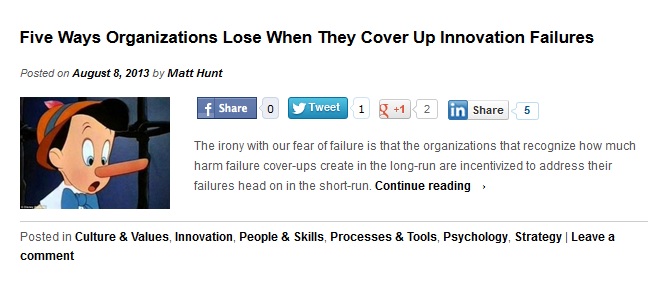
When executives are allowed to hide their innovation failures the entire organization suffers. False expectations are set for the entire group of executives, innovation leaders see their careers scuttled, and every other employee fails to learn from the failure. Without clear organizational expectations of documenting, sharing, and learning from our failures we will continue to see them covered up. Left to our own devices we will naturally seek to avoid our failures and move into self-preservation mode. In my work helping organizations to build strong innovation processes this is a common issue but it can be resolved.
Below is my published article from the Innovation Excellence Blog on the Five Ways Organizations Lose When They Cover Up Innovation Failures.
—-
Five Ways Organizations Lose When They Cover Up Innovation Failures
We may not want to admit it but attempting to cover up our failures is as American as baseball and apple pie. Our athletes (think Lance Armstrong and Alex Rodriguez), our politicians (think Eliot Spitzer and Anthony Weiner), and our business leaders (think Richard Fuld, Jr. of Lehman Brothers and Jeff Skilling of Enron) have all tried desperately to cover-up their failures in an attempt at self-preservation.
These are just a few examples but there could be volumes written on all of the failure cover-ups that splash the headlines on a daily basis. Our failures embarrass us. They hurt us emotionally and economically. They can limit our careers, impact our compensation, or even get us fired.
The irony with our fear of failure is that the organizations that able recognize how much harm failure cover-ups create in the long-run are incented to address their failures head on in the short-run.
When organizations are just starting out they will experience frequent failures as they try to innovate and build their operating model. But as these organizations get bigger there’s a noticeable shift from risk taking to risk management. The more new employees an organization hires the more likely it will be that not everyone will know or trust each other. Eventually many of these organizations lean toward political bureaucracies where divisional infighting and self-preservation become the status quo.
This all sounds bad but it doesn’t need to be this way. With determined leadership, teams or entire organizations can create an environment where smart risk taking is encouraged and innovation failures are tolerated but first they must understand how much harm the cover-ups are creating.
Concealed failures set the wrong standard for the entire organization
When executives are allowed to cover-up their failures it sets a precedent for every employee in the organization to learn from. The message is clear in that is more important to protect your brand than to be open and honest about the outcomes. This norm can quickly permeate throughout the organization.
A failure cover-up pushes out some of your most talented employees
When failed innovation initiatives get shutdown the project leader often struggles to stay with the organization. Where failures are “punished” these leaders are frequently seen as a political liability to executives who would rather distance themselves from the failure. President Kennedy said it best when responding to a reporter’s question on the Bay of Pigs, “victory has 100 fathers and defeat is an orphan.”
Severely punishing failures will influence other employees to reconsider their risk taking
Psychologist Albert Bandura coined the term “Social Learning Theory” over 30 years ago to describe how we all learn from one another’s actions and the resulting consequences. Just like children on the playground we learn from watching each other in the workplace. If we see others experience negative consequences that are disproportionate to the rewards we will adjust our behavior to take on less risk. As this cycle repeats organizations are left with few people willing to lead the next risky innovation initiative.
Hidden innovation failures create false expectations for future success rates
When failures are covered up, few people within the organization have realistic expectations of how difficult innovation work really is. They come to expect to find success more than they find failure when in fact the odds are reversed. These false expectations will impact critical aspects of the organization, including: strategic planning, budgeting, and compensation.
Obscuring failures prevents the entire organization from learning from them
The most impactful consequence is that when only a handful of people know why an initiative really failed then only a few people can actually learn from it. Soon enough others will try to replicate the project not knowing that it had been tried before. Alternatively, the initiative might have been a great idea that just needed time or a few changes to become successful but without an understanding of the lessons learned it won’t likely be tried again.
Seeing the process of innovation as a system helps to highlight how shortsighted leaders are being when they cover up their innovation failures. This system is comprised of processes: 1) action, 2) reaction, and 3) adjustment. When we short circuit the failure and cut off the reaction feedback loop we are signaling expectations to our employees and we fail to learning from our mistakes. In this scenario, organizations are unable to adjust their strategy to find success in the future because they don’t understand their failures along the way.
Covering-up failures may be in the individual’s short-term interest but it is never in the organization’s long-term interest. One way that I personally tried to build a tolerance for innovation failure with a previous employer was by creating a series called the Failure Forums. We gave innovation leaders the opportunity to share their stories and we gave the audience the opportunity to learn from these failures. Each session was presented by the innovation leader and covered what was accomplished, what was learned, and what would they have done differently. It may not have been revolutionary but it was evolutionary in trying to build a culture that tolerated innovation failures.
Food for thought:
Additional Articles:
A few weeks ago I wrote a post on how Jeff Bezos creates opportunity for vast discovery at Amazon (my post Amazon Drives Innovation by Creating Opportunities for Vast Discovery). I had actually been working on this post at the time when I found a great quote from Bezos on the culture of “pioneering” that he was trying to create at Amazon. It made for such a great story that I just had to run with it and push this story aside. Well, Bezos has done it again. He threw the world another curveball yesterday with the announcement that he is purchasing The Washington Post for $250 million. The pundits are in a whirlwind discussing whether or not Bezos will be successful with this big gamble. Knowing Bezos and his long-term orientation I would give him better odds than most that he will find success.
Over and over Bezos has defied Wall Street analysts with his willingness to take short-term losses when he thought they would lead to long-term gains. On the importance of this long-term orientation, he shared “I think some of the things that we have undertaken, I think could not be been done in two to three years. And so basically if we needed to see meaningful financial results in two to three years some of the most meaningful things we’ve done we would never have even started: things like Kindle, things like Amazon Web Services, Amazon Prime the list of such things is long at Amazon.”
Bezos recognizes that this long-term approach is what allows him to take on some of the riskier innovation initiatives that Amazon has gone after. Bezos is quoted as saying, “We like to invent and do new things and I know for sure that long-term orientation is essential for invention because you’re going to have a lot of failures along the way.”
This open recognition that failures will be a part of the process is still somewhat rare in Corporate America but it has been a staple with Bezos since he started Amazon. “We are stubborn on vision. We are flexible on details…. We don’t give up on things easily. Our third-party seller business is an example of that. It took us three tries to get the third-party seller business to work. We didn’t give up.” This reminds me of Ron Johnson’s story of how it took 18 months to figure out how to get customers to engage with Apple employees at the Genius Bar (see The Failure of Ron Johnson and JCPenney). Great ideas can be difficult to execute and it is unlikely that you’ll get it right the first time.
As I had written in my last post, Bezos has done a great job of cultivating employee curiosity in service of the customer. He has invested in exploring with and in service of the customer. With this understanding he is building offerings that will make customers love Amazon even more. Many of Amazon’s competitors see customers only in terms of profits (catch my post Do your customers love you? Have you really asked them?) but not Amazon. Bezos stated that, “Some companies, if you wanted to put it into a single word they kind of have a conqueror mentality and we have an explorer mentality. And the people who like our mentality of exploration and pioneering they tend to stay here and have fun here and this is self-reinforcing.”
It is far too early to tell how The Washington Post purchase will play out for Bezos but one thing that you can be certain of is that he is willing and ready to take a long-term approach to solving the woes of print media. Good luck Jeff!
Food for thought:
Last week I was in a golf tournament for my college fraternity Beta Theta Pi and had the pleasure of being grouped with several current students. After a few stories of debauchery and crazy antics from over twenty years ago we got on to the subject of careers. One of the students mentioned that he was majoring in Information Systems which also was my undergraduate degree. The discussion triggered a flashback of the amazing amount of discovery that seemed to be bombarding me at that time in my life. Looking back over my “career path” I now realize how I have continually struggled to maintain that extraordinary sense of discovery I felt then.
As I talked about my career, I enjoyed recounting how I was actually “on the Internet” before there was “the Web” and boasting about how terrible my graphic arts skills were. I recently pulled up the first website I had launched almost twenty years ago for the University of Minnesota’s Carlson School of Management. The website was the first web server for the Carlson School and one of the university’s first as well. If you want a good laugh you can see if for yourself via the Wayback Machine, an “Internet archive” that takes a snapshot of every website over time. Our work wasn’t pretty but we were all figuring it out as we went along. We knew that leading discovery meant constantly trying new things and being vulnerable to our imperfections. Our only guidebook at the time was Zen and the Art of the Internet: A Beginner’s Guide by Brendan Kehoe.
Over the last year I have talked with hundreds of individuals about innovation and risk taking. From these discussions I’ve heard a consistent theme emerg.:
Throughout our personal and professional lives there is a gradual shift from
risk taking and discovery to playing it safe.
We still learn new things but over time it is usually over a narrower band of disciplines; we will begin to specialize. It may not be this explicit but sometime in college we are told that the time for vast discovery is over and that we have to declare a major. In the business world we are told that we need to choose a career path. If we just follow the path in front of us our options are usually pretty clear: we focus on marketing, supply chain, accounting, information technology, etc. The further we specialize in our field the more money we are able to make but the narrower our future choices become and the less we are exposed to work of other disciplines.
As I was doing some research on Amazon’s model for innovation I came across an HBR interview with CEO Jeff Bezos describing how he tries to create a culture of discovery. He said, “We have an explorer mentality. And the people who like our mentality of exploration and pioneering they tend to stay here and have fun here and this is self-reinforcing.”

Amazon’s own history could be described as a series of vast discoveries: book e-retailer, e-retailing superstore, web services provider, to hardware designer and manufacturer. They are taking a long-term orientation and letting their business model constantly evolve as they discover new areas to grow their business. Investors seem to have agreed with this long-term approach by shrugging off the company’s $7m quarterly loss as the stock price ($AMZN) remains near its all time high.
There is a fine balance with this model though. A company needs to have subject matter experts that can lead the business but they also need individuals who are humble and curious. They want innovators who understand the limits of their current knowledge and seek to make the vast discoveries that will propel the organization forward.
Food for thought:
With so many people preaching advice on failure these days (Fail Early, Fail Fast, Fail Often) I thought it might be worth trying to clarify the difference between a failure and a mistake. So often the media loves to amplify the drama surrounding failures by highlighting all of the negative connotations. Words like nosedive, bomb, flop and collapse are frequent synonyms used for failing and each one tries to convey the severity of a failure that may or may not be appropriate. By working toward a common definition we may be able to short circuit the negative implications and fear that many people have with the word failure.
A failure is when something that you were trying to accomplish
fell short of what was required or projected.
Simply, it was a failure to reach expectations. This failure could be a personal or professional. Maybe you failed to get into the college of your choice? Maybe your sports team failed to get into the playoffs? Or maybe your new product launch failed to reach your expected customer adoption rates?
In this context there is a very subtle distinction between a mistake and a failure that is worth pointing out. A mistake is an incorrect, unwise, or unfortunate act or decision. A mistake can be caused by bad judgment, a lack of information, or a lack of attention to detail. While a mistake can lead to failure they don’t always have to end in failure. We make numerous mistakes every day of our lives without serious consequence. We would prefer to avoid making mistakes but without perfect attention and perfect prediction they are inevitable.
Failure is different. It is about having a plan, attempting to execute that plan and not accomplishing the goal for any number of reasons. In getting into your college of choice it might be that your grades weren’t high enough, your essays weren’t compelling enough, or simply that all of the other candidates were even more amazing this year. In launching that new product it might be that the company wasn’t capable of delivering the product or service, the customer wasn’t ready to use the product or service, or maybe the product or service didn’t deliver against set expectations.

Some of these failures fall within the responsibility of the individual or the company but many of them do not. Sometimes you can run tests against these criteria in order to make changes and potentially avoid the failure but depending on the product or service that’s not always possible; see my post on Disney’s failed launch of The Lone Ranger. Another great example of this phenomenon was with the launch of New Coke. Every sign from their test marketing pointed to the idea that most consumers in the United States liked the new sweeter flavor of New Coke but a small cadre of loyalists made a huge roar when the company wanted to change “their” product. In this case the few outweighed the many but it highlights how even a sure thing can turn into one of the most spectacular product launch failures ever.
My point is that failures don’t always stem from mistakes and sometimes they simply cannot be avoided. I would prefer that we call them what they are, failures, and that we get more comfortable talking about them so we can move away from fearing them and hiding from them. When we hide from our failures we will never learn from them – and that will be our real failure. I absolutely love Thomas Edison’s perspective on failure, “I have not failed. I’ve just found 10,000 ways that won’t work.”
You can help me to create the distinction between failures and mistakes by sharing this perspective with others! If you disagree please share your thoughts in a comment!
One of the things I hate most about our sensationalist news media is how quick we are to label someone as a failure after they have failed. One of the topics that I focus on with my consulting practice is that being innovative requires failing frequently but that doesn’t equate to being a “Failure.” This is true in the arts as well as in business. Perhaps television audiences don’t tune-in to our new show, theater goers skip our new release movie (see my Lone Ranger post), or customers choose not to buy our new product. Each of these are all very complicated endeavors, each with an infinite amount of variables that we can try to control for. We can layout the most thorough and thoughtful plan but sometimes we will miss the mark – we will fail.
Back in May, Jon Lovett (@jonlovett) delivered the commencement address for Pitzer College. If you have heard of Pitzer don’t worry, neither had I until I saw the video of Lovett’s speech. The school, which is situated in Claremont, CA or about 40 minutes due east of Los Angeles, is a small liberal arts college. Students create their own academic programs and are expected to engage in community service learning and give back to their communities. It sounds nice. What I found interesting about this story was that the students at Pitzer have a unique tradition of selecting their own keynote speaker who will deliver their commencement address. These students didn’t pick your typical speaker.
To allow for the necessary preparation and planning for the commencement ceremony the selection of the speaker must be done months in advance. Just a few months earlier Jon Lovett must have been flying high. He seemed to have everything going for him.
Lovett had been a successful speechwriter for former senator and presidential candidate Hillary Clinton (@HillaryClinton). After Hillary had lost the nomination, Lovett had gone on to work as a speechwriter for President Barack Obama (@BarackObama). He left that role to jump into yet another high profile endeavor. Lovett became the co-creator and head-writer for the NBC comedy series 1600 Penn. He had never written a line of television dialog before in his life. But by the time he was on stage to give his commencement address to the graduating class of 2013 – Lovett had failed. Just a little over a week earlier it was announced that his new show had been cancelled.
Coming off what must have been one of Lovett’s biggest failures in his life, he went on to deliver one of the funniest and insightful commencement addresses I have ever seen or heard. In his speech he seems to spare no one with his cutting wit, laying into judges, business professionals, students, teachers, and parents too.
Here are five nuggets that Lovett had to offer but I would encourage you to spend the 17 minutes and watch the entire speech!
“Now is the time to take risks. Now is the time not to be safe. There would be time for safe, that there would be time for offices and stability… and sacrifices… and savings accounts. But this was the rare moment when a human being could be free.”
“One of the greatest threats we face simply put is bullshit. We are drowning in it.”
“It is not mutually exclusive to be competent and humble, to be skeptical and eager to learn.”
“Subway rule – if you see something, say something… to call BS when you see it.”
“Lesson #3 – Being honest about what you do know and what you don’t can and will pay off.”
Lovett finishes he speech with the line “You’re going to do extraordinary things and I can’t wait to see what is next.” At only 30 years old he has a long road ahead of him… beyond his failed television show, he too will do extraordinary things and I personally can’t wait to see what is next. Jon Lovett’s television show might have failed but he is far from a failure.
———————————————————-
Receive periodic email updates from Matt Hunt including his published pieces, updates on his progress, and more!


